
River Days Australian Labradoodles is a reputable producer of puppies who have become Certified Therapy Dogs. This title was not given to us through marketing, but through the real-world successes of our puppies and their families. Dogs like Bear, Brody, Jesse and Eno and others have become Certified Therapy dogs. They bring joy and comfort to people in care facilities, schools, and hospitals.
This page talks about what therapy dog certification means, what it takes to get it, how therapy dogs are different from service dogs, and why the temperament of the Australian Labradoodle makes it one of the best breeds for this meaningful job.
What Is a Therapy Dog?
A therapy dog is a dog that has been trained and certified. To give emotional support, affection, and psychological support to individuals other than their owner in controlled, supervised situations. Therapy dogs and their handlers go to schools, universities, libraries, hospitals, nursing homes, memory care facilities, crisis response and disaster relief settings, courthouses to help child witnesses and trauma survivors, and mental health and counseling programs.
The dog’s job is to be a calm, friendly, and reliable presence that assists individuals who are stressed, anxious, lonely, or in emotional suffering. Studies regularly demonstrate that animal-assisted contact diminishes cortisol levels, lowers blood pressure, and enhances mood. Frequently when alternative therapies prove inadequate.
Therapy dogs are not taught to do certain things for one disabled person. Their gift is temperament: they are naturally kind, gentle, and sensitive to persons they have never met.
What Does Therapy Dog Certification Require?
Therapy dog certification is not simply a matter of a dog being friendly. It is a certification that shows the dog has been thoroughly tested in real-life scenarios. As well as determined to be safe, stable, and successful in a wide range of settings and situations. The most well-known technique to get certified includes the following steps.
Minimum Age
Most places that undertake therapeutic work with dogs want them to be at least one year old before they can be evaluated. This makes sure that the dog is emotionally mature enough. Puppies, no matter how smart they are, don’t have the calm demeanor that therapy settings need.
Read our Australian Labradoodle Puppy 1 year guide for more information about puppy development
AKC Canine Good Citizen (CGC) Test or Equivalent
Most people think that the AKC Canine Good Citizen (CGC) certification is the minimum level of obedience for therapy dogs. It tests 10 basic skills: being able to welcome an engaging stranger, sit still while being petted, walk on a loose leash through a crowd, sit and stay on command, come when called, stay calm when there are distractions, and behaving appropriately when left with a trusted person.
A lot of groups also want an enhanced version, like the AKC Community Canine (CGCA) or the AKC Urban CGC (CGCU), which tests behavior in real life in busier, more complicated public places. The Advanced Puppy Training Program at River Days is made to help puppies learn the skills and public behavior that are in line with the CGC program.
Temperament Evaluation
In addition to basic obedience, therapy dog examiners look at a dog’s natural disposition, such as how it reacts to strange sounds, sudden movements, medical equipment, new odors, crowded settings, and humans in distress. A dog that is obedient but anxious, reactive, or too excited would not pass. Evaluators want dogs that are calm and at ease in new places, friendly with all kinds of people, genuinely interested in strangers, and able to bounce back fast from stressful situations without losing their cool.
Genetics and early socialization are quite important here. A dog raised in a well structured environment from birth, with a variety of experiences, the right amount of stimulation, and regular interaction with people, is much more likely to pass than one that hasn’t. This is why River Days raises our puppies on a time-tested and proven puppy curriculum from the time they are born.
Read more about the Australian Labradoodle’s temperament
Handler Training
The dog is only a part of the team. Most organizations that train therapy dogs require handlers to take a class that teaches them how to interpret dog body language, follow visit protocols, deal with difficult situations in care settings, and understand the responsibilities that come with bringing an animal into a vulnerable environment. The handler must always be able to keep both the dog and the persons they are visiting safe and comfortable.
Supervised Practice Visits and Final Evaluation
Most programs require the dog-and-handler team to undergo a series of supervised practice visits before a final in-person evaluation. This is usually done in the same type of real setting where the pair would be working, such a hospital floor or a classroom. This last phase makes sure that everyone can be counted on to do their job well in real life, not simply in controlled test settings.
Ongoing Certification and Insurance
Getting certified as a therapy dog is not something you do once. Reputable groups need active membership, annual recertification, and proof of continued health and vaccinations. Most of them also have liability insurance that protects the dog and handler team while they are on official trips. Canines for Therapy, Pet Partners, the Alliance of Therapy Dogs, Therapy Dogs International, and the AKC Therapy Dog Program are some of the most well-known groups in the US.
Therapy Dog vs. Service Dog: What’s the Difference?
People sometimes mix up these two terms, although they mean distinct things and have different legal protections and training requirements.
A therapy dog trains to give emotional support and comfort to many individuals during planned visits to care facilities. The handler and the therapy dog work together. They can’t just go anywhere; their visits take planning with the places they work for. It is their job to be friendly to those they don’t know.
The Americans with Disabilities Act (ADA) protects service dogs that trained to accomplish certain duties for one person with a recognized disability. This lets the dog and handler go to most areas, like restaurants, stores, and public transit. People who are working with service dogs shouldn’t pet them, because it can make them lose focus on their handler. Common tasks for service dogs include helping individuals who can’t see well, alerting them to medical emergencies, fetching things, and stopping behaviors associated to anxiety or PTSD.
An Emotional Support Animal (ESA) is a third, independent type of animal. A licensed mental health expert prescribes an ESA to a specific person as a form of therapy. ESAs don’t need any training or certification, and fair housing law doesn’t protect them very well. They also don’t have public access rights and are not the same as a therapy dog or service dog.
The easiest way to remember the distinction is that a service dog helps one person, a therapy dog helps many people, and an emotional support animal helps one person cope better.
Why Australian Labradoodles Excel as Therapy Dogs
The Australian Labradoodle was first bred in Australia to be an allergy-friendly guide and assistance dog. The breed’s DNA has that basic goal inscribed into it: a dog bred to work closely with and for people.
A natural fascination with people. Australian Labradoodles are quite good at picking up on how people are feeling. They naturally walk toward people who are sad, upset, or in need of consolation, even though without prior training. This instinct is quite useful in treatment situations.
Coats that don’t shed much and are generally good for people with allergies. A lot of therapeutic settings help people with allergies or breathing problems. The Australian Labradoodle’s fleece or wool coat doesn’t shed much, if at all, and most individuals who are allergic to other breeds can handle it. This makes it possible for them to work in more places.
Temperament that is calm and stable. When selectively bred and appropriately maintained, multigenerational Australian Labradoodles have the calm, steady personality that therapy work needs. They are not too hyper or too shy, which would make them ineligible for certification.
How easy they are to train and how smart they are is a measure of their trainability. For therapy work, dogs need to be able to respond to their handler in situations that are unpredictable and full of strong feelings. Australian Labradoodles are very smart and eager to learn. They also do well in real-life situations, not just controlled ones.
The right size range is also an important factor! River Days raises miniature to medium-sized Australian Labradoodles. These sizes are great for hospital beds, school floors, and nursing home visits where a very big dog might not be practical.
Meet Some of Our Certified Therapy Dogs!
We are very proud of the River Days dogs who have become Certified Therapy dogs. These dogs are proof of what careful breeding, thorough early growth, training, and the proper temperament can do.
Brody — River Days Certified Therapy Dog

We take pride in serving alongside Brody in volunteer work throughout the Raleigh and Chapel Hill areas as part of his certified therapy teams. Brody’s steady temperament and love for people make him a natural fit for this meaningful work.
Jesse — River Days Certified Therapy Dog
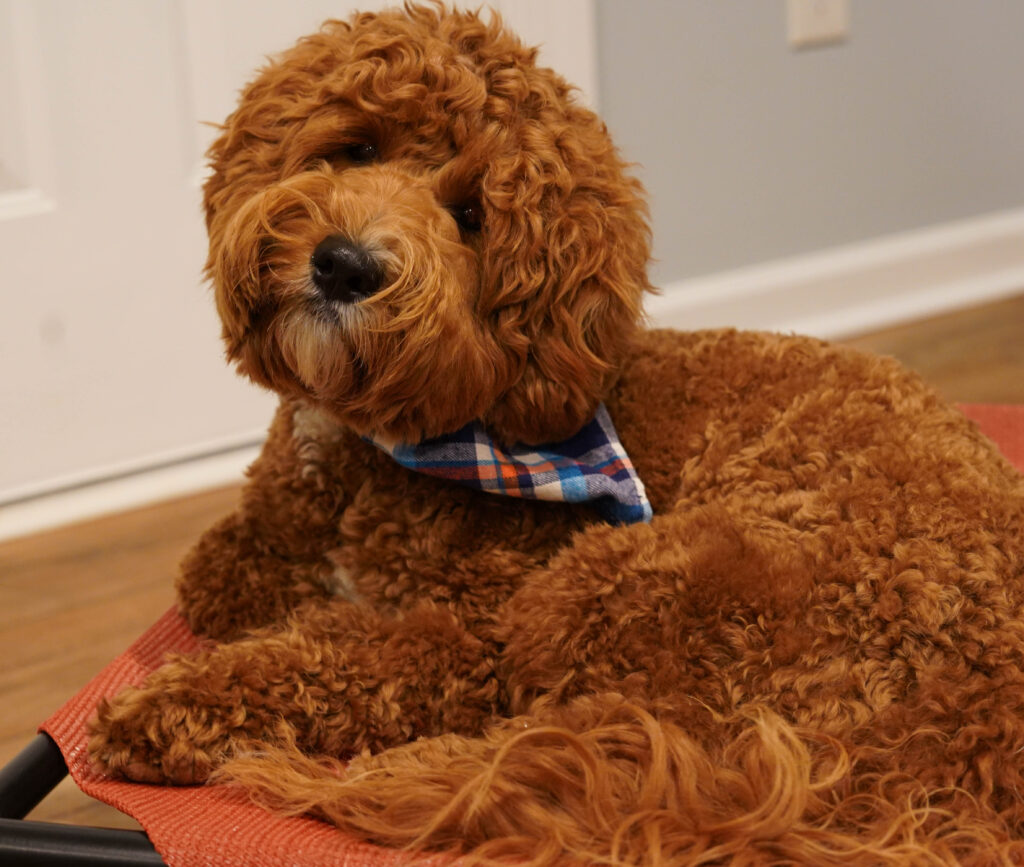
Jesse has an innate ability to connect with those around him. His calm confidence and wonderfully intense eye contact create an immediate sense of trust and engagement.
Bear — River Days Certified Therapy Dog

Bear’s emotional intuition and with a natural ease in training, having passed the AKC Canine Good Citizen (CGC) exam with our 8-year-old son as his handler — a true testament to the bond they share.
Eno — River Days Certified Therapy Dog

Eno’s journey to a certified therapy dog represents exactly the potential we breed and raise every litter to achieve. His legacy lives on through our lines, now 3-4 generations later in some cases– with anticipation over the future generations to come!
Do you have a River Days puppy who has earned a therapy dog certification? We would love to hear from you and celebrate your team’s achievement. Please reach out — your story inspires future families.
The River Days Foundation: Built for This Work
Therapy dog certification does not begin the day a dog walks into a testing room. It starts on the first day of a puppy’s life, when the breeder takes decisions about genetics, health, and early growth.
Breeding for temperament in a selective way. Every pairing decision we make prioritizes the social, intuitive temperament that is the foundation of therapy and family work. We don’t breed dogs that are too sensitive, anxious, or reactive.
From the time they are born, our puppies have structured neurological stimulation, early socialization, and a gradual introduction to new people, sounds, surfaces, and settings. We don’t only write about it; we demonstrate it on our social media in real time with every litter.
Chronic pain, discomfort, and health problems that aren’t handled can make even a generally calm dog act out. Our health testing requirements, which align with the Orthopedic Foundation for Animals (OFA) CHIC requirements and more, include OFA hips, eyes, cardiac, and patella, PennHip, and breed specific genetic panel. This testing not only preserves physical health but also the long-term soundness that therapy work needs.
Advanced Puppy Training Course. Our Advanced Puppy Training Program gives families a head start by building the CGC-aligned obedience foundation that most therapy dog certification programs require. Graduates leave us with appropriate public conduct, loose-leash walking, long sit/down/stay commands, and emotional control abilities they need to take the next step toward certification.
Frequently Asked Questions About Therapy Dogs
What organizations certify therapy dogs?
Canines for Therapy, Pet Partners, the Alliance of Therapy Dogs (ATD), Therapy Dogs International (TDI), and the AKC Therapy Dog Program are some of the most well-known organizations that certify therapy dogs in the United States. Each has its own way of judging members, rules for visits, and criteria for documenting visits, but all demand proof of obedience, a stable temperament, and willingness to handle.
How long does it take to certify a therapy dog?
Most dogs start the certification process when they are between 12 and 18 months old, which is when they are emotionally ready. The amount of time it takes to get ready for and pass the certification test varies from organization to organization and dog to dog. However, teams that start with a strong obedience foundation, like those in our Advanced Puppy Training Program, are much better able to move through the process quickly.
Does a therapy dog need to be professionally trained?
It is not necessary to have professional training, but it is a big plus. The most important thing is that the dog can reliably execute a command in real-life situations and that the handler knows how to read their dog and handle visits responsibly. A lot of families train their dogs well by doing a mix of group classes, private lessons, and regular work at home.
Can a therapy dog also be a family pet?
Yes, and this is one of the best things about working with therapy dogs. Service dogs are generally on the job even at home, but therapy dogs are usually family pets. Therapy visits needs scheduling ahead of time and usually happen once or twice a week. When they’re not working, every River Days puppy is exactly what they were bred to be: an amazing family dog!
Are River Days puppies suitable for therapy work?
River Days puppies are bred from the ground up to have the right personality, health, and aptitude to learn what therapy work needs. We are happy to be a proven Certified Therapy Dog producer because our program produced numerous certified therapy dogs. If you want to work in therapy, please let us know when you apply. This helps us find a puppy whose natural personality is a perfect match for that career.
Ready to Begin Your Journey?
Whether your goal is a devoted family companion, a future therapy dog, or simply the most thoughtfully bred Australian Labradoodle puppy in North Carolina; River Days is ready to talk. Start your application now or learn more about our adoption process.
© 2017 River Days Australian Labradoodles. Our content and images are protected under federal copyright laws. We do not give permission to duplicate our content or images.